
虎牙直播
Kansas Voters Reject Amendment to Strip Abortion Rights From State Constitution By Nearly 2-1 Margin_我的网站

一 | By nearly a 2-1 margin, Kansas residents heading to the polls Wednesday declined to reverse a 2019 ruling by the Kansas Supreme Court establishing the right to abortion.,The vote is a major repudiation of recent legislative moves curtailing reproductive rights – most notably the Supreme Court’s June decision to overturn Roe v. Wade.,One middle-aged woman who brought her 16-year-old daughter to the polling station reportedly told the AP that she wanted her child “to have the same rights [her] mother has had most of her life.”,The proposed amendment was sponsored by Value Them Both, a coalition led by Kansans for Life, the Kansas Catholic Conference and Kansas Family Voice. One of the lawyers responsible for crafting the failed constitutional amendment reportedly described the measure as an attempt to keep Kansas from becoming an “unlimited destination for abortion.”,A number of Kansas residents reported being subjected to a last-minute text message campaign seemingly aimed at fooling pro-choice voters into voting for the anti-abortion proposal. The mass messaging platform being utilized, Twilio, has not identified the party responsible.,We’ve gotten several emails from KS voters getting this text. To be clear:A YES vote changes the KS constitution to state it does NOT protect abortion rights. It gives power to lawmakers to set regulations.A NO vote keeps legal abortion protections in place. pic.twitter.com/2N3UDFvRMn— Cody Holyoke (@CodyKMBC) August 2, 2022,But Kansas voters were seemingly unconvinced. With over 99% of the ballots counted, a full 60.86% rejected the Value Them Both’s amendment. Only 39.14% – or just over 275,000 of the nearly 715,000 estimated total voters – cast their ballots in favor.,Between abortion providers and Catholic dioceses, over $14 million was ultimately spent in the state in an effort to sway the outcome of the vote.。

二 |
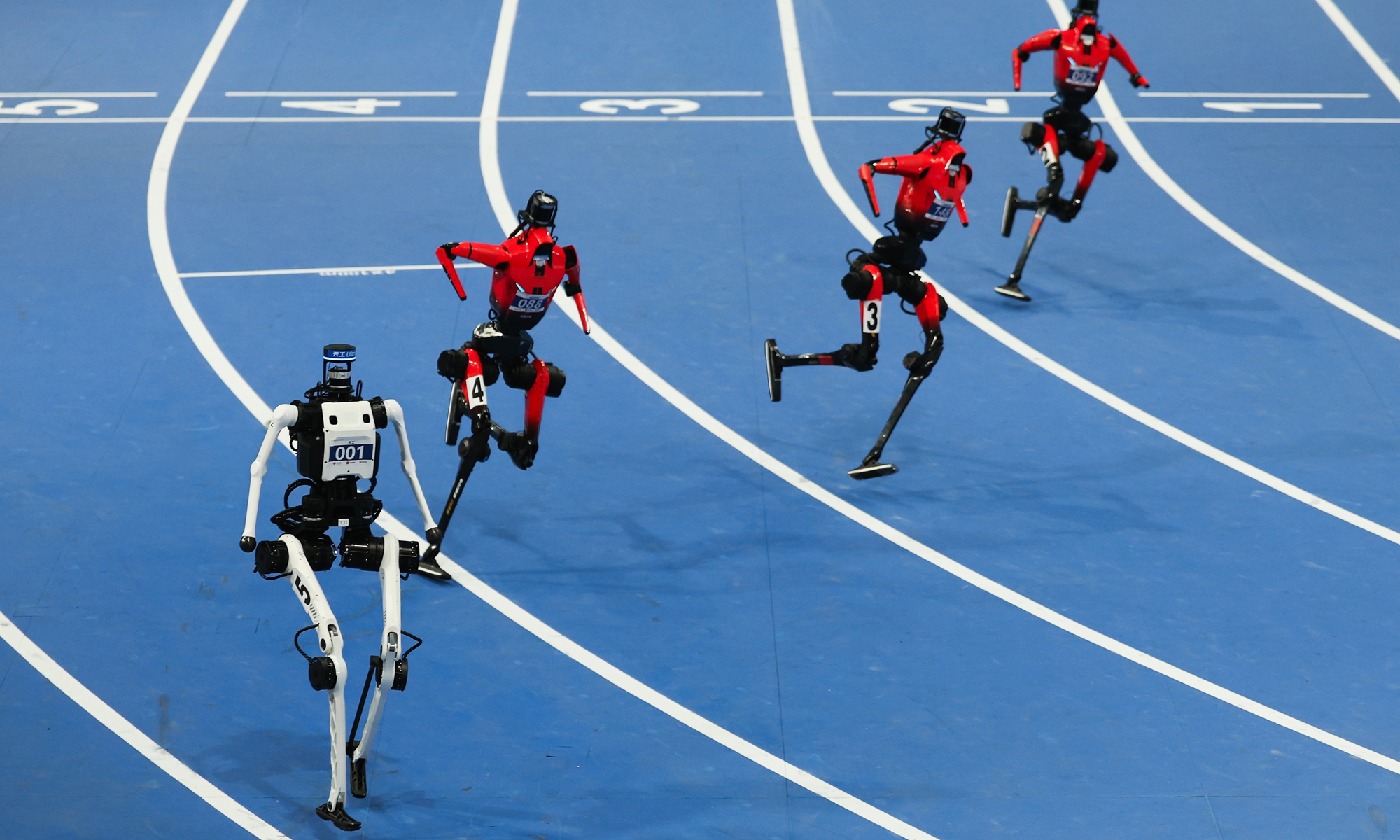
On the blue track inside the National Speed Skating Oval, robots chased each other in the 400-meter race. A sprinting Tien Kung robot was tripped by a rival robot lying on the track but did not fall. Instead, it adjusted its posture in seconds and continued toward the finish line with a result of 38.15 seconds, breaking human 400-meter race world record of 43.03 seconds, held by South African athlete Wayde van Niekerk.
This scene unfolded on Sunday, the first official competition day of the 2nd World Humanoid Robot Games (WHRG). Later that evening, a humanoid robot named Lightning, developed by Honor Co., broke the long-standing human 1,500-meter world record of 3:26 set by Moroccan athlete Hicham El Guerrouj with a time of 2:30.22. Just one night earlier, during the opening ceremony's 100-meter sprint and high jump demonstrations, humanoid robots had already shattered records long held by human athletes Usain Bolt and Javier Sotomayor — merely an appetizer for the five-day sci-fi spectacle.
The Games have attracted 666 teams from 16 countries across six continents, up 138 percent from its inaugural edition. The number of participating robots quadrupled to 2,056, the Global Times learned from the organizing committee.
Yet the biggest change this year was not only the scale, but also the technological maturity. More teams have shifted from remote-controlled robots to fully autonomous systems. Chinese observers, after watching several events, said humanoid robots are no longer limited to simple demonstrations of walking or dancing. Increasingly, they are being tested in environments that demand speed, coordination, perception and decision-making.
From movement to intelligence
Behind the record-breaking performances are a series of technological upgrades. During the running events, Global Times reporters observed that robots were able to make subtle movements around their hip joints while walking, allowing them to maintain balance and produce movements closer to human biomechanics.
Guo Yijie, technical director of Tien Kung Ultra, said the improvement came from advances in hardware design.
"Robot joints have improved in torque and speed. As competitions demand higher power output, the reliability of the main control board, power board and high-power battery discharge capability have become increasingly important," Guo told the Global Times.
According to Guo, the same Tien Kung Ultra robot was used in both sprinting and jumping events. For running, the waist needs rotation to balance the inertia generated by leg movements. For jumping, the upper body requires pitching movement to help the robot achieve greater distance or height, Guo said, noting that these can all be achieved with only slight adjustments to the waist configuration were needed, and it highly demonstrated to the robot design's flexibility.
Besides the hardware upgrades, developments in robots' faster decision-making in "brains' is better showcased in football competitions.
The Booster T2 robot used by many domestic and overseas football teams has increased its onboard computing capability by 10 times compared with the previous generation. The time from recognizing the goal to deciding whether to pass or shoot has been reduced to around 100 milliseconds - faster than the time humans usually need to blink.
Cheng Hao, a technical representative from Boosters Robotics, said the improvement represents an "end-to-end" transformation in embodied intelligence.
"In the past, robots relied on separate steps: perception, planning, decision-making and execution. Each stage was disconnected. Now, with an end-to-end motion foundation model, visual input can directly generate joint control commands," Cheng said.
The newly introduced table tennis and tennis competitions are also testing another important capability: perception.
"Robots are moving from simply recognizing the three-dimensional position of a ball to understanding the movement information of opponents and more complex environments," said Li Yinghui, a postdoc researcher and the leader from the Hong Kong University team at the table tennis event. Such capabilities developed in sports scenarios could eventually be transferred to other scenarios in industries or daily life, Li said.
Beyond entertainment
Though clips from the robot competitions have made a buzz on social media, with some critics from Western media questioning why robots need to dance, play football or compete in athletics while arguing that these activities appear far from everyday needs.
Zhou Changjiu, Vice President of the RoboCup Federation and the Robotics Competition Association of the Asia-Pacific (RCAP), stressed robot sports are not designed for entertainment alone. "Robot competitions are testing the capabilities needed for humanoid robots to enter the real world," Zhou told the Global Times.
Different events evaluate different abilities. Sprinting tests speed, marathons examine battery endurance and energy management, while football provides a comprehensive test because of its dynamic and unpredictable nature, testing intelligence, manipulation, interaction, safety, cost and trust at the same time, Zhou said.
Unlike a single-task demonstration, football requires robots to cooperate. Players must understand their own roles, recognize teammates and opponents, and make collective decisions - a form of swarm intelligence that could become essential when robots work together in homes, factories and emergency rescue environments.
Entertainment, however, can generate business opportunities. Gu Jinghai, brand director of EYOU Robot Co, told the Global Times that the company sold 95,000 integrated joints in China in 2025 and expects sales to exceed 1 million units in 2026. Growth mainly comes from planetary joints used in entertainment robots, while harmonic joints for industrial robots are also expanding steadily, he said.
Jiao Jichao, an executive from UBTECH Robotics, said the criticism that "Chinese robots can only sing and dance" reflects only a temporary stage of development. "Performance and dancing are also real commercial demands, and their existence has value," Jiao said. "Beyond entertainment, Chinese robots are already demonstrating intelligent capabilities that support practical applications in manufacturing, and partnerships with companies including Huawei and Foxconn, where robots have already entered production lines in small-scale applications."
The Outline of the 15th Five-Year Plan for National Economic and Social Development of China stated that the country will construct a comprehensive cultivation system for future industries including the embody intelligence as new economic growth drivers.
Zhou said the development of humanoid robots is not only about individual machines, but about building an entire ecosystem.
China's advantage lies in its complete supply chain, abundant application scenarios and manufacturing capabilities, while the fast growing industry still faces challenges such as the lack of unified standards.
Gu said the company has launched mass production of robotics joint under domestic standard of auto parts.
Robot competitions can help address these issues by creating common standards in areas such as competition rules, robot dimensions, communication systems, batteries and joint modules. "As applications expand, the cost of key robot components will continue to decline," Zhou said.
"Numbers are magic," Zhou said. "If producing one robot costs a huge amount because it is handmade, producing one million robots will completely change the cost structure."
For humanoid robots, the race taking place inside the Ice Ribbon may not ultimately be about who crosses the finish line first. It may be about whether these machines can learn to navigate the far more complicated race outside the stadium - the race into the real world.
。

三 |
Current article:http://81sq2iz.fanfutaopoulaxiong.pics/orm/20260826/695067.html
Published on:09:45:27
 10月1日起 家办申请税务奖励须提供背景调查报告
 张韶涵演唱会突发身体不适,医护人员紧急上台
 深水规院:公司本期计提各项资产减值准备合计约2939万元
 小鹏的泪别纸巾,特斯拉的三分糖奶茶……为何温情牌爱翻车?
 1.3万元起的RTX 4090根本买不到 区域总代也只有1-3块
 世界杯之后,卡塔尔怎么样了?